


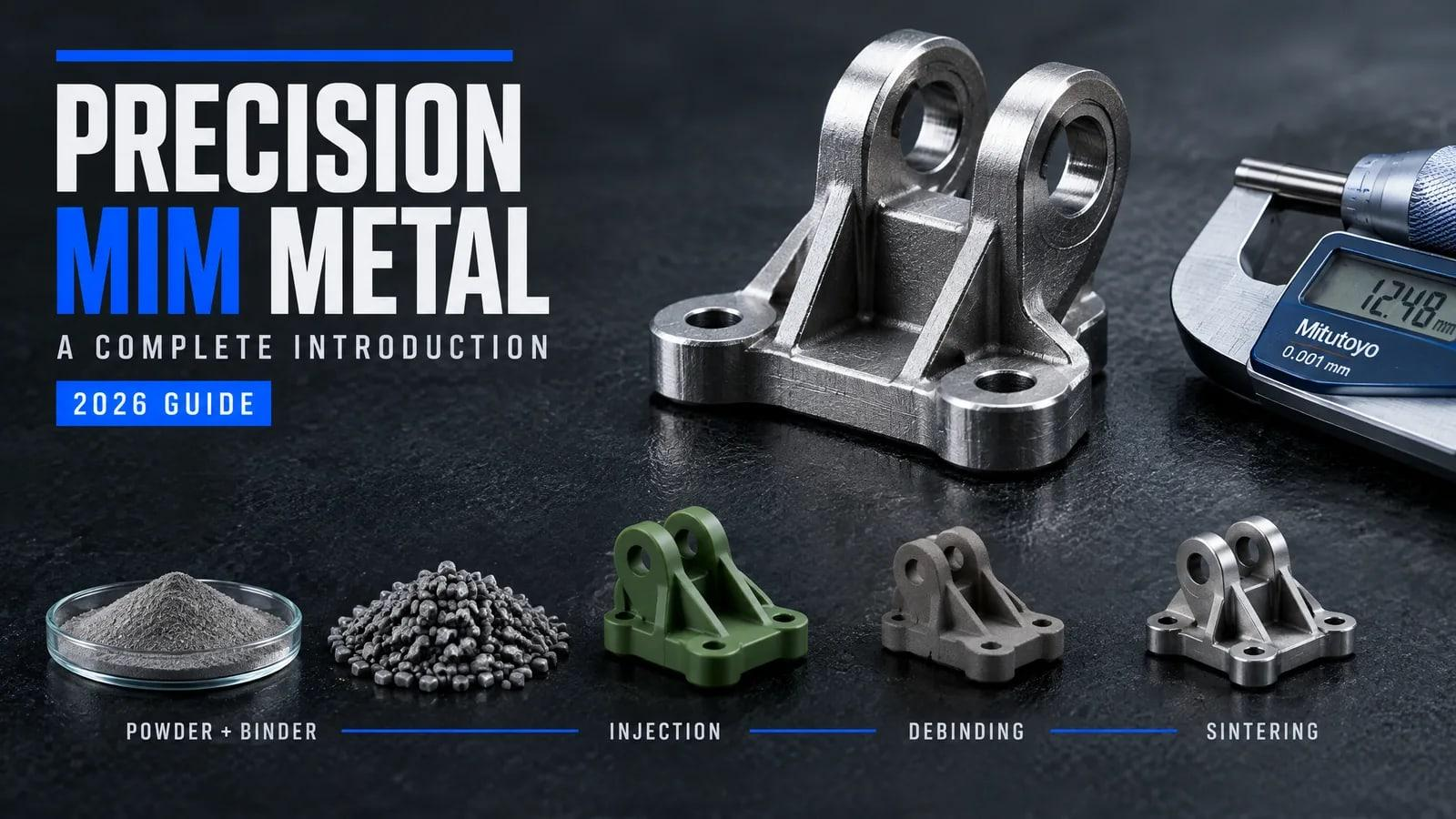
 Metal injection molding is a manufacturing process which combines a metal powder with a binder (plastic) which is then injected into a mold. Once injected, the binder is removed and the part is sintered into a dense metal. High volume production of small, complicated components having very tight repeatable tolerances is best suited.
You probably already know CNC machining and die casting. Perhaps you have heard MIM called plastic molding for metal. Many general overviews fail to discuss many things such as what precision means in millimiters, when the published volume and size limits disagree, what to do when MIM is the wrong call, and so on. This guide outlines the methodology, materials and standards and then provides a decision framework for 2026.
Main Points.
● The process of metal injection molding combines very fine metal powders with a binder to produce a feedstock suitable for injection molding. After cooling, the component is debonded and then sintered.
● MIM is suitable for parts that are small and geometrically complex and which typically weigh under about 100 grams. Reported weight limits vary by source from about 100 g to about 240 g (3ERP, 2025; Indo-MIM, 2025).
● MIM tolerances are expressed in percent of the dimension (about ±0.3–0.5% as-sintered), not in a fixed value. CNC machining can have very tight tolerances (TFG USA 2026).
● Sintering reduces the dimensions of a part by 15-20%. Therefore, design and tooling must take sintering into consideration (Proleantech, 2026).
● MIM is typically less expensive than CNC machining but only for higher volumes The breakeven points released vary between 2,000 – 5,000 to over 10,000 units depending on the part.
● MIM alloys examples 316L and 17-4 PH stainless steels. Standards, such as MPIF Standard 35-MIM and ASTM B883, govern material specifications.
● MIM does not work well with prototypes, very large parts and the tightest tolerances. Programs increasingly shift from CNC to MIM as their production volumes expand.
What is precision metal injection molding?
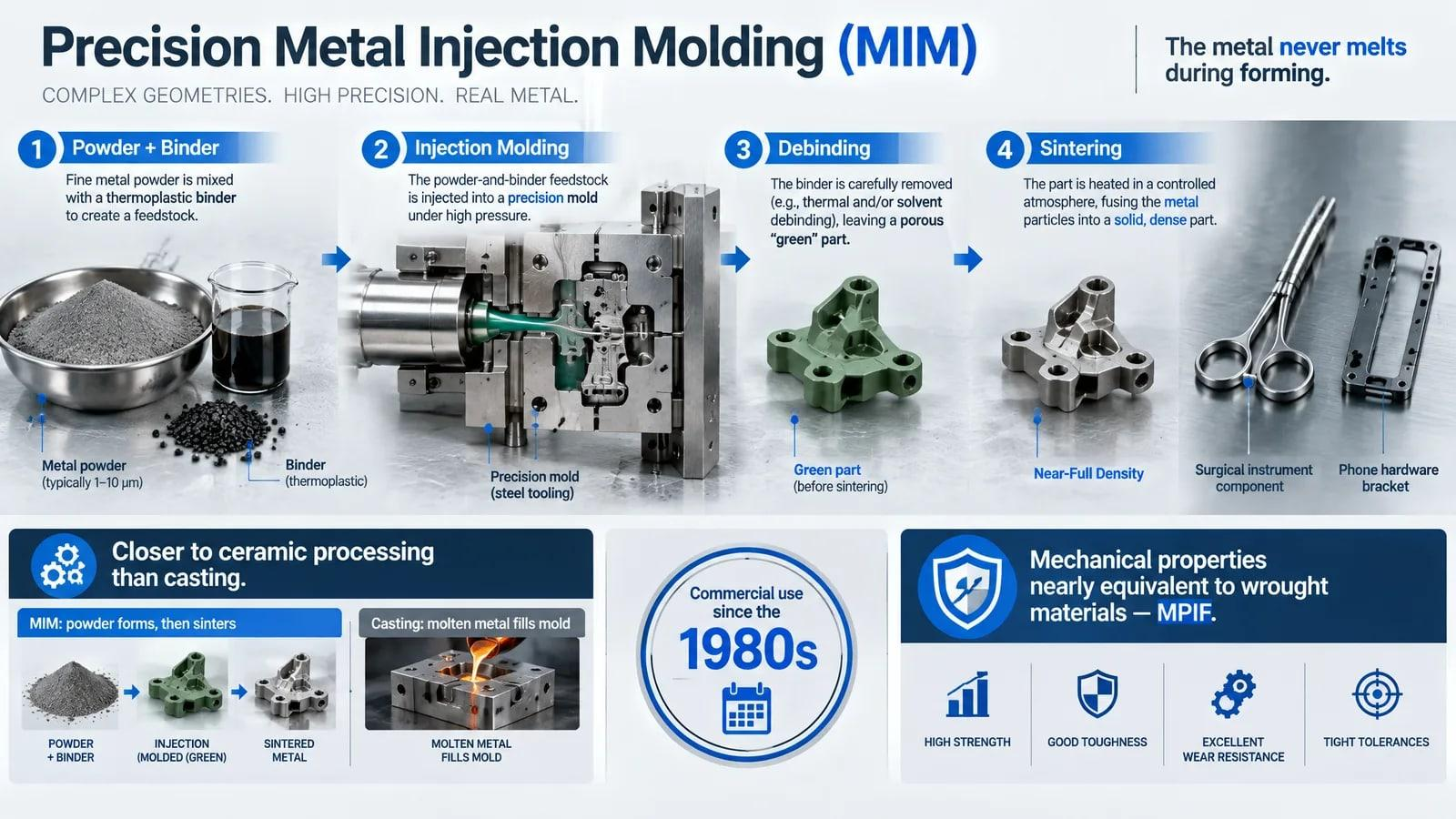
Precision metal injection molding forms little metal parts using a powder metallurgy process. More specifically, a powder-and-binder mix is injected into a mold, and then sintered to near-full density. The metal does not melt plastically during forming. MIM is closer to ceramic processing than to casting which is a common point of confusion.
MIM, or metal injection molding, is a powder metallurgy technique whereby fine metal powder and a binder mixture is produced which is subsequently shaped by injection moulding, as explained by Wikipedia. The method has been commercially used since the 1980s, which is mature technology. These days, MIM parts vary from surgical tools to phone hardware.
According to the industry trade association, the Metal Powder Industries Federation (“MPIF”), it has “the capability to produce mechanical properties that are virtually identical to those of wrought materials” (MPIF). This means repeatable dimensions, precise geometry, high density and a good surface finish.
Since there is no liquid form, MIM does not have solidification stage control. The focus of dimensional issue now shifts to effective shrinkage management, next section explains.
What Are the Procedures of MIM Process?
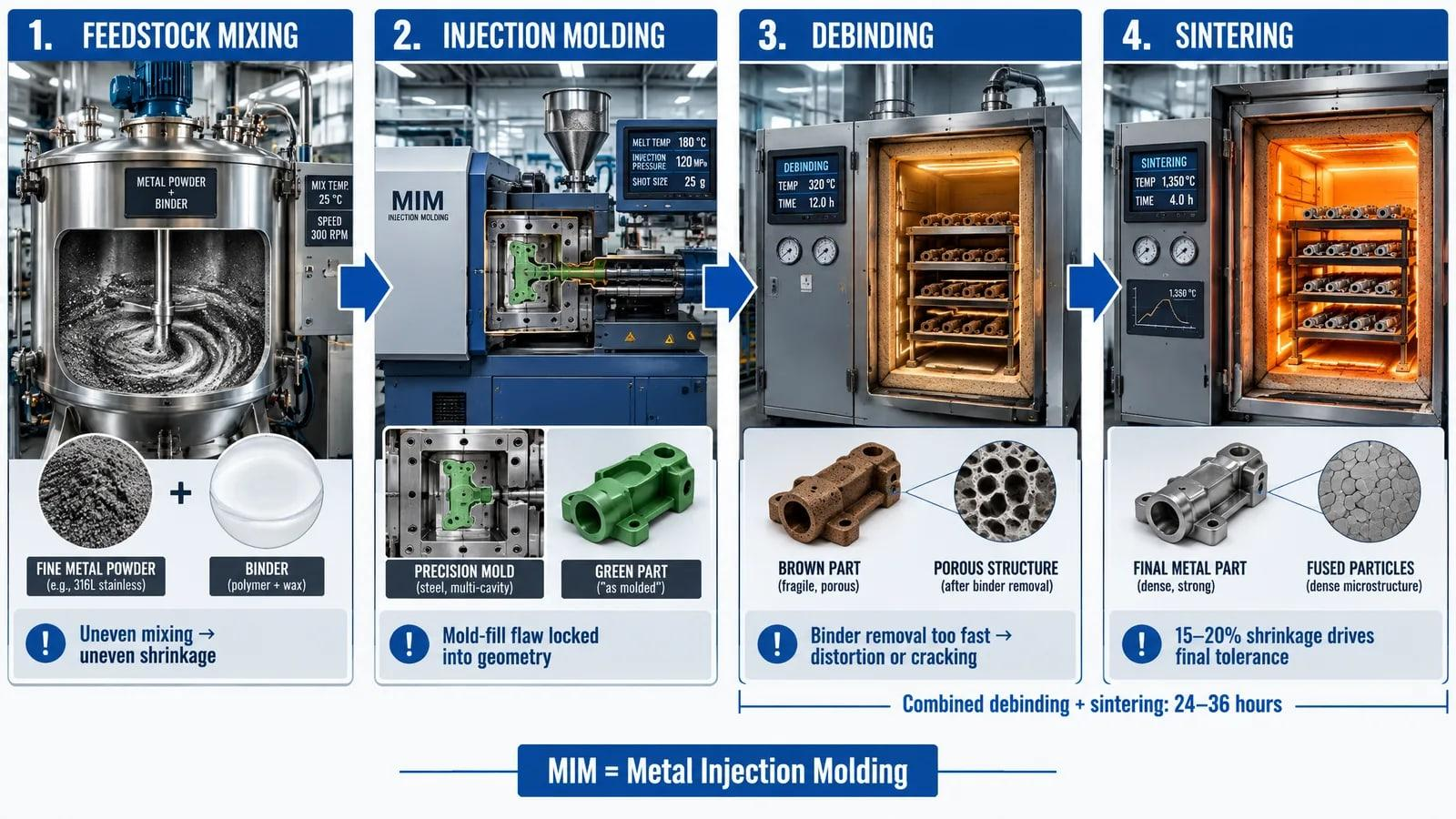
The MIM process involves four steps, including feedstock preparation and injection molding. There is one principal precision risk per step.
1. Blending of fine metal powder with a binder. When mixed inconsistently, shrinks will vary accordingly.
2. The feedstock fills the mold and makes a green part through injection molding. Risk: any faults in the mold-fill will be locked-in as all the geometry exists here.
3. The brown component is weak and porous with the binder removed There is a risk of distortion or cracking if the binder leaves too quickly.
4. The part is heated so the particles fuse but not hot enough to melt the metal. Shrinkage of about 15–20% drives final tolerance (Proleantech 2026).
The process of debinding and sintering together takes about 24 to 36 hours, and 95-99% theoretical density is achieved in parts. Adjust the delivery schedule according to this action.
Here’s how shrinkage works in practice. Consider a linear shrinkage of approximately 15–20%. A finished 10 mm feature must be molded to approximately 11.8 mm (10 ÷ 0.85) and 12.5 mm (10 ÷ 0.80). The supplier’s shrinkage data give the exact number that tooling needs to hit that oversize target.
How accurate is metal injection molding?
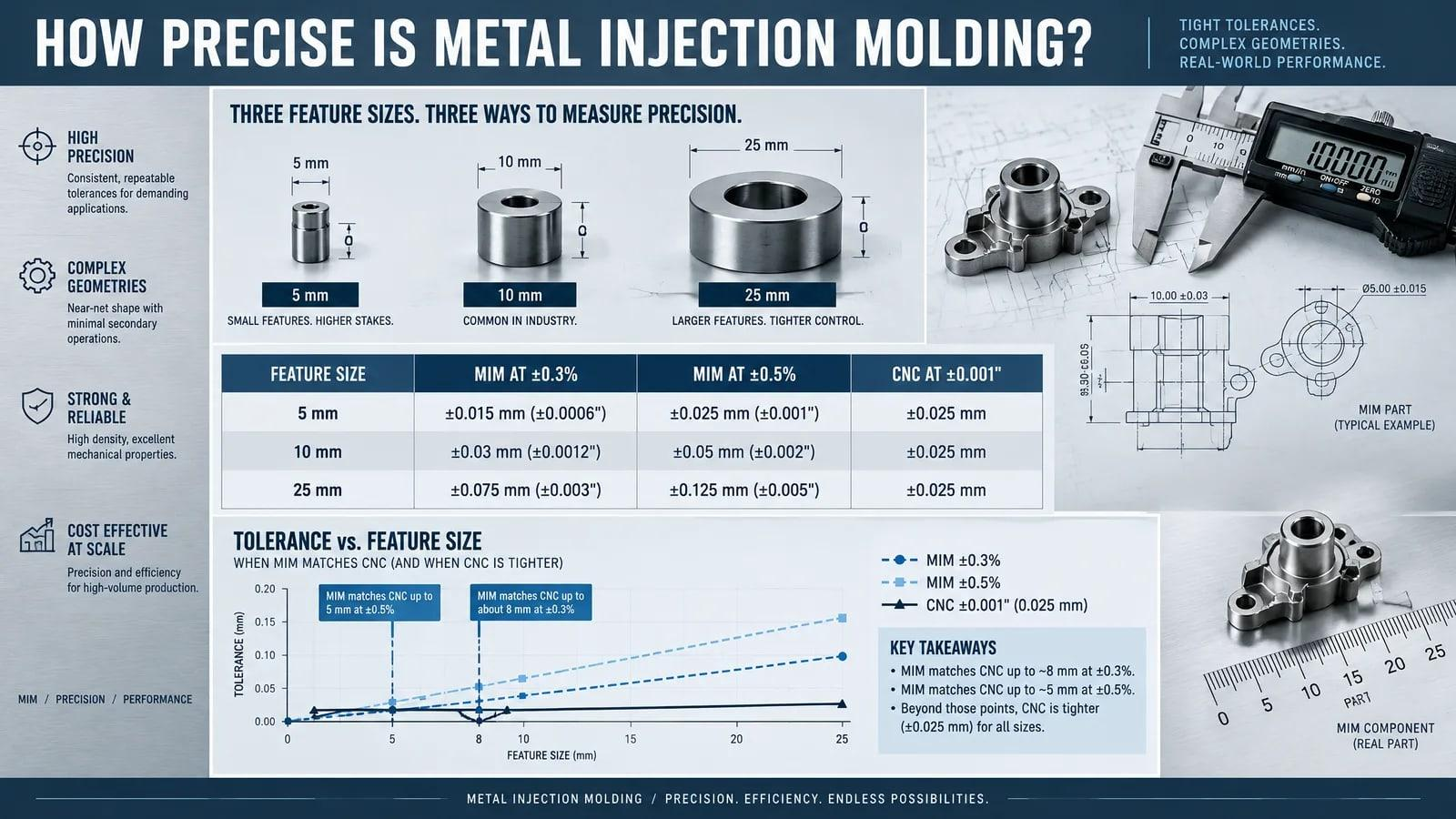
According to MIM, a ±0.3% of the nominal dimension is typically attained. Other sources report ±0.3-0.5% as-sintered (Proleantech, 2026; TFG USA, 2026). It is difficult for you to use percentages on a drawing, so they have converted them to mm and inches in the table. The CNC column takes advantage of ±0.001", about ±0.025 mm.
Feature size | MIM at ±0.3% | MIM at ±0.5% | CNC at ±0.001" |
5 mm | ±0.015 mm (±0.0006") | ±0.025 mm (±0.001") | ±0.025 mm |
10 mm | ±0.03 mm (±0.0012") | ±0.05 mm (±0.002") | ±0.025 mm |
25 mm | ±0.075 mm (±0.003") | ±0.125 mm (±0.005") | ±0.025 mm |
A crossover is shown in table. At a rate of ±0.3%, MIM achieves tolerances that are similar to those of CNC machining at a rate of ±0.001” for features as large as about 8 mm (0.025 to 0.003). When looking at tolerances of ±0.5%, that break point drops to 5 mm. Further into the part sizes that exceed those values, CNC machining maintains the tighter absolute tolerance.
Since the sources diverge and the shape has an influence, treat these figures as indicative only. TFG USA mentions CNC tolerances between ±0.001" or tighter. (Source: TFG USA, 2026) This applies to non-critical features only. For critical features (such as bearing bores, sealing faces, etc.), specify a secondary machining operation, along with stock to leave.
What are the metals and standards for MIM?
Stainless steels like 316L and 17-4 PH, plus tool steels such as M2, low-alloy steels and titanium are common MIM alloys. Choose the alloy based on the characteristic that is most important for your part.
Alloy | Best for | Typical use |
316L stainless | Corrosion resistance | Medical, consumer hardware |
17-4 PH stainless | Strength and hardness after heat treatment | Structural, firearm, tool parts |
M2 tool steel | Wear resistance | Cutting and wear components |
Titanium | Low weight, biocompatibility | Medical, wearables |
Low-alloy steels (4140, 4340, 8620) | Strength and toughness | Gears, mechanical parts |
The material produced by MIM is not fully wrought-equivalent. According to Markforged, the density of MIM 17-4 PH H900 is 95.5% which is close to 100% for wrought ASTM A564 H900. The implication is that approximately 4.5% of the volume of the part consists of pores. This is important information that should be noted, especially for fatigue-loaded or plated parts.
There are three standards with quotes. The MPIF Standard 35-MIM 2025 edition is already available. The MIM materials are also included in ASTM B883 and ISO 22068:2012. Inquire from each supplier which density they are certified to.
Choosing MIM Over CNC or Die Casting: When
If you want small and complex parts in the thousands, choose MIM. For prototypes or the tightest tolerances, CNC is the process. You want larger parts that can make use of die casting. The table provides a comparison.
Factor | MIM | CNC machining | Die casting |
Cost vs. volume | High tooling; cheaper at volume | No tooling; cheaper at low volume | High tooling; cheaper at volume |
Tolerance | Percentage-based | ±0.001" or tighter | Depends on alloy and size |
Part size | Small, typically under 100 g | Wide range | Larger parts possible |
Materials | Stainless, tool steel, titanium | Almost any machinable metal | Mainly low-melting alloys such as aluminum and zinc |
Lead time | Tooling plus 24–36 hour furnace cycle | Fastest to a first part | Tooling plus fast cycles |
MIM is not a good option for prototypes. This is because high tooling costs make low-volume runs not feasible. According to TFG USA it is better to remain with CNC below 2000 units/year.
It is common to launch on CNC, prove the design and then cut a MIM tool when volume justifies it. The two processes are complementary A common drawing can serve both purposes if essential characteristics are maintainable.
What is the source of MIM limit disagreements?
MIM limits differ because the sources are measuring something different: shot weight, finished part weight, or the economic sweet spot. This table compares the figures with each other.
Metric | Published figures | Likely reason for the gap |
Part weight | About 100 g per shot (3ERP, 2025); 0.5–150 g (Total Materia); up to 240 g, with economics at 50 g or less (Indo-MIM, 2025) | Shot size vs. product weight vs. cost |
Breakeven vs. CNC | 2,000–5,000 units (TFG USA, 2026); 10,000+ units (Patsnap Eureka, 2025) | Geometry, material waste, tooling amortization |
Density | 95–99% of theoretical (Total Materia) | Alloy and process control |
The breakeven spread is equivalent to five times. A complex component requiring extensive machining might approach nearly 2000 units crossover. CNC production can manufacture easily one week, but some need 10,000 for more. Employ the range for planning, then for your volume obtain quotes for both processes.
What Should You Check Before Requesting a MIM Quote?
Prior to quotation request, verify volume, alloy, density target, tolerance and finish. A brief checklist does away with most redesign loops.
● Both annual and lifetime units matter because breakeven depends on both.
● MPIF 35-MIM, ASTM B883 or ISO 22068 alloy and standard, plus the density you need.
● To millimeters per feature, convert percentage tolerances. Indicate any that require secondary machining.
● Try to keep the weights of all parts well under 100 g.
● The capacity of TFG USA in MIM processes- The thin-wall capability of TFG USA is about 0.015 (TFG USA 2026).
● According to HLH Rapid, it is advisable to include a flat face in the furnace support as this reduces sintering deformation.
● Inquire about the plating or coating, as the porosity that can make a difference.
How Big is the Market for MIM Parts and Which Industries Use Them?
MIM technology is used in the manufacture of industrial and automobile components and serve electronic devices, firearms and aerospace. Market size projections differ by publisher.
Publisher | 2025 estimate | Outlook |
Grand View Research | USD 6.5 billion | USD 13.5 billion by 2033 (Grand View Research, 2026) |
The Business Research Company | USD 4.71 billion | USD 5.14 billion in 2026 (The Business Research Company, 2026) |
Global Market Insights | USD 4.2 billion | USD 8.8 billion by 2035 (Global Market Insights, 2026) |
The highest figure of 2025 is roughly 55% greater than the lowest figure. Different definitions mean different results, so don’t do this. According to Global Market Insights, electronics will be up at USD 1.18 billion 2025, about 28% of its own total. Check out our precision metal parts for similar capabilities.
Connect with Harber Metal for Advanced Precision Metal Manufacturing Products.
At Harber Metal, we’ve been producing revolutionary precision metal manufacturing solutions since 2014. Metal Injection Molding (MIM), Powder Metallurgy, and CNC machining are the methods we use for the manufacturing of top-quality complex metal parts. We help businesses in the automotive, aerospace, medical devices, and electronics industries reduce their production costs, improve their efficiency, and meet demanding quality standards. Our experienced professionals can accommodate both custom fabrication and volume production to suit your requirements cost-effectively. Harber Metal would love to hear more about your project! Get a quote today.
Common inquiries.
Is Precision MIM Capable of Producing Sub 1 Gram Parts?
MIM can manufacture components that weigh less than 1 gram. According to Total Materia, one published range begins at a level of 0.5 g. The supplier and the tooling determine capability below. Request evidence on a comparable component before committing.
Is Secondary Machining Necessary for Precision MIM?
Not every time Secondary machining is necessary when a feature has to be tighter than the percentage tolerance as-sintered. Bearing bores and sealing faces are typical examples. Indicate certain characteristics on the sketch so the supplier leaves machining stock.
What is the smallest feature of precision MIM could produce?
The Americans at TFG USA mention that their thin-wall capability is approximately 0.015” (roughly 0.38 mm) (TFG USA, 2026). Smaller features depend on geometry, alloy and supplier process. Verify limits with a design review before cutting tooling.
Is Precision Micro MIM Good for Small Batch Production?
Generally not. The high cost of tooling makes small batches unfeasible. TFG USA recommends CNC below 2000 units per year. Start with CNC for initial batches, switch to MIM as ramp up.
Is it possible to coat or plate Precision MIM parts?
Usually, yes, but check with your supplier first. The density of MIM parts reaches 95–99% of the theoretical density, so some porosity still exists. It may influence plating quality. Advise the coating type to the vendor at the earliest to facilitate density and surface preparation.
Conclusion.
The MIM technology is best suited for small, complex metal parts in their thousands but not for designs at the tolerances or in prototypes. Before you ask for quotes, you need to gather three components: annual volume, tolerances in millimeters per feature, and alloy and standard required. Now check at your real volume MIM and CNC quotes. Numerous programs leverage both, starting in CNC and expanding in MIM on a large scale.


